What Tasks Should I Delegate to a Virtual Assistant?
The hardest part of hiring a virtual assistant is often not finding someone. It is deciding what to give them.
A virtual assistant can handle many administrative and operational responsibilities, but that doesn't mean every task should be delegated.
The best place to start is with work that is repetitive, predictable, time-consuming, and possible to explain clearly.
You should generally keep tasks that depend heavily on your expertise, personal relationships, confidential judgment, or major business decisions.
Start with the work you repeat every week
Look at your calendar and task list from the last few weeks.
Which responsibilities keep appearing?
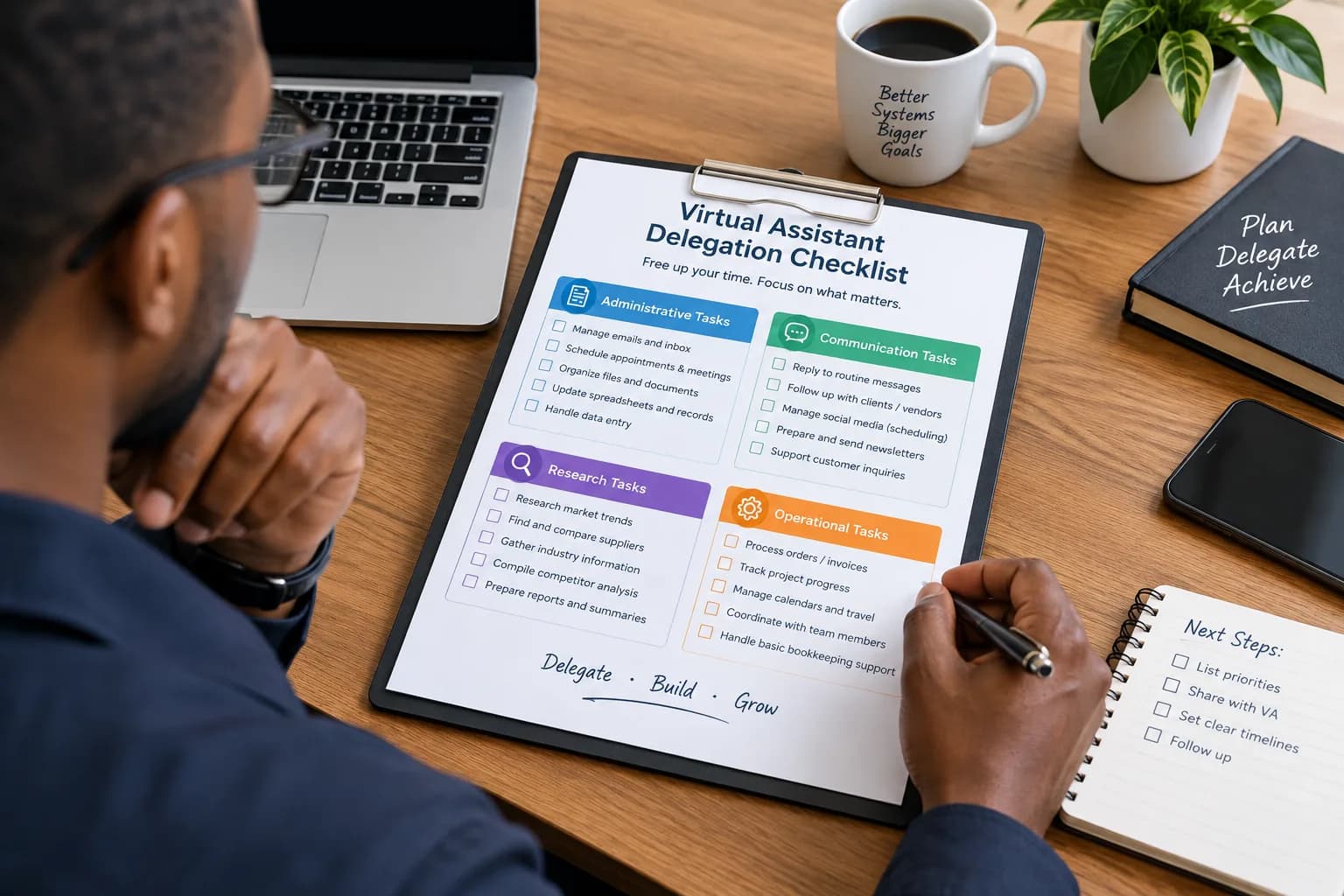
You might find that you're spending hours on:
- Scheduling
- Data entry
- Research
- Customer follow-ups
- File organization
- Document preparation
- Online research
- Reporting
- Administrative coordination
These are strong candidates because they happen repeatedly.
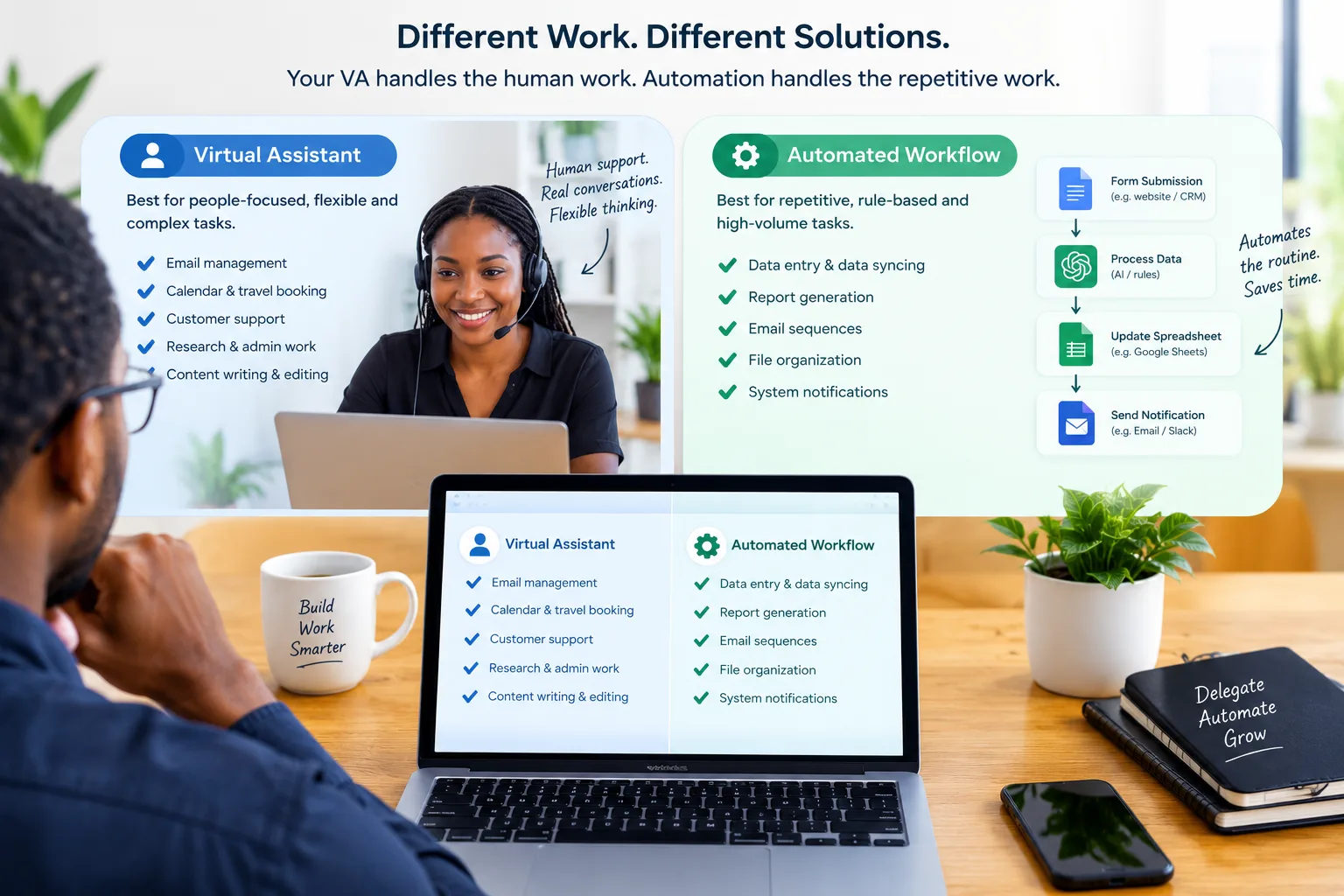
1. Email management
Email is one of the most obvious delegation opportunities.
A virtual assistant can:
- Sort incoming messages
- Organize folders or labels
- Flag urgent emails
- Draft routine responses
- Send approved replies
- Follow up with people who haven't responded
- Remove or organize low-value messages
You should establish clear rules about which emails require your involvement.
2. Calendar and appointment scheduling
Scheduling seems simple until several people, time zones, rescheduling requests, and conflicting appointments are involved.
A virtual assistant can manage:
- Meeting requests
- Appointment bookings
- Calendar invitations
- Rescheduling
- Meeting reminders
- Basic scheduling correspondence
Instead of negotiating every meeting personally, you can give your assistant defined availability and rules.
3. Data entry
Data entry is rarely the most strategic use of a business owner's time.
A virtual assistant can update:
- Customer records
- Spreadsheets
- Contact databases
- Inventory records
- CRM information
- Internal tracking documents
The key consideration is accuracy.
If the information is sensitive or mistakes would have serious consequences, establish appropriate controls and review procedures.
4. Research
Research can consume far more time than expected.
A virtual assistant can gather information for:
- Competitor research
- Supplier lists
- Potential clients
- Industry information
- Travel planning
- Product comparisons
- Contact details
- Background information
The assistant can collect and organize the information while you handle the final analysis and decision-making.
5. Customer follow-ups
Many businesses lose opportunities simply because follow-ups are inconsistent.
A virtual assistant can maintain a follow-up list and contact people according to your instructions.
For example:
- New enquiry arrives.
- Assistant records the enquiry.
- Initial response is sent.
- Follow-up is scheduled.
- Assistant reminds you if personal involvement is required.
This creates a process instead of relying on memory.
6. Document preparation
You may not need to personally spend time formatting routine documents.
A virtual assistant can help prepare:
- Reports
- Meeting notes
- Presentations
- Proposals
- Internal documents
- Templates
- Spreadsheets
You can provide the substance while the assistant handles formatting and organization.
7. Travel and meeting logistics
Business travel involves many small administrative tasks.
A virtual assistant can research:
- Flights
- Accommodation
- Meeting locations
- Transport options
- Itineraries
- Scheduling conflicts
For important bookings, you can retain final approval while allowing the assistant to do the research and preparation.
8. File and document organization
A disorganized digital workspace creates hidden costs.
A virtual assistant can help establish consistent systems for:
- File names
- Folders
- Shared documents
- Client records
- Archived projects
- Meeting notes
The exact system matters less than having rules that everyone follows consistently.
9. Basic reporting
If you regularly collect information from several places and turn it into a standard report, that process may be delegable.
For example, an assistant can gather data, update a spreadsheet, format the report, and highlight missing information.
You can then review the finished report rather than building it from scratch.
10. Routine social media administration
Depending on the business and your strategy, a virtual assistant may support administrative aspects of social media.
Tasks can include:
- Scheduling approved posts
- Organizing content
- Collecting comments for review
- Maintaining a content calendar
- Preparing basic reports
- Researching relevant topics
Strategic brand decisions and sensitive customer interactions may still require your direct involvement.
The delegation test: should you keep it or hand it off?
When deciding whether to delegate a task, ask five questions.
Is it repetitive?
If you perform it every day or week, it is worth examining.
Can you explain the process?
If you can create a checklist or demonstrate the workflow, the task may be suitable.
Does it require your expertise?
If the task depends on your unique knowledge or authority, you may need to keep it.
What happens if someone else makes a mistake?
Low-risk tasks are generally easier to delegate initially.
Is your time better spent elsewhere?
This may be the most important question.
A task can be easy to delegate but still not worth outsourcing if it takes only five minutes a week.
Tasks you should think carefully about delegating
Some responsibilities require more caution.
These may include:
- Legal decisions
- High-value financial decisions
- Sensitive employee matters
- Confidential negotiations
- Strategic business decisions
- Personal communications
- Final approval of important contracts
- Sensitive customer complaints
The issue isn't whether a virtual assistant is capable.
The issue is whether the responsibility should remain with the person who has the authority, expertise, or relationship required to handle it.
Don't delegate everything at once
One common mistake is handing over dozens of responsibilities on the first day.
That can create unnecessary confusion for both you and the assistant.
Instead, start with two or three clearly defined tasks.
For example:
Week 1: Email organization and calendar management.
Week 2: Add customer follow-ups.
Week 3: Add research or reporting.
As the assistant learns your systems, you can expand the role.
Create simple standard operating procedures
A standard operating procedure, or SOP, is a written description of how to perform a recurring task.
A useful SOP doesn't need to be complicated.
It can contain:
- Purpose of the task
- When it should be completed
- Step-by-step instructions
- Tools required
- Examples
- What to do when something unusual happens
- When to escalate the issue to you
Good documentation makes delegation more reliable and makes it easier to train another person if responsibilities change later.
A simple delegation priority list
If you're unsure where to begin, rank your tasks using this framework:
| Task type | Delegation priority |
|---|---|
| Repetitive and time-consuming | High |
| Repetitive and easy to document | High |
| Administrative but important | High |
| Requires occasional approval | Medium |
| Requires specialist expertise | Medium/Low |
| Strategic decision-making | Low |
| Highly personal or confidential | Usually low |
This isn't an absolute rule. Your business may have different requirements.
The best task to delegate is often the one you keep postponing
Look at the tasks you repeatedly say you'll "get to later."
If a task is important but never gets enough attention because it competes with higher-value work, delegation may be the answer.
A virtual assistant doesn't need to replace your entire administrative function.
They simply need to remove enough recurring work that your time is spent where it creates the greatest value.
Start with one task.
Document it.
Delegate it.
Review the result.
Then decide what should move off your plate next.